You want a university degree.
But you also have a job.
Or a business.
Or you're trying to learn a skill and make money at the same time.
The last thing you want is to spend four years waking up at 5 a.m. because you have an 8 a.m. lecture somewhere on the other side of Lagos.
So you start looking at online universities.
Then the debate begins.
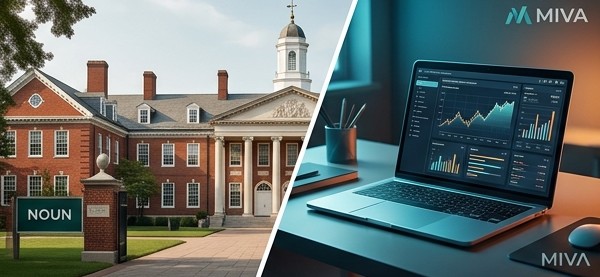
"Do NOUN."
"No, check Miva. Their online system is better."
"NOUN is federal abeg."
"Miva is more modern."
At this point, everybody has an opinion. Very few people have actually compared the two properly.
So let's do that.
Miva University vs NOUN: which one makes more sense for a Nigerian student in 2026?
The quick answer
If your biggest concern is cost, course variety and having an established Nigerian institution behind your degree:
NOUN wins.
If you care more about a modern, digital-first learning experience and you're comfortable paying more:
Miva wins.
And if NYSC is important to you, read that section very carefully before doing anything.
Because that one can change the whole decision.

1. Which one is cheaper?
NOUN. By a mile.
Let's start with the thing most Nigerian parents will ask first:
"How much?"
NOUN's published undergraduate fee schedule is dramatically cheaper than Miva's. NOUN currently lists ₦36,000 in compulsory fees for new undergraduate students and ₦18,000 for returning students, with additional charges for examinations, projects and other items. (nou.edu.ng)
Miva currently lists undergraduate tuition starting from ₦300,000 per year. Its programme information shows ₦150,000 per semester for Management programmes and ₦175,000 per semester for Computing and Allied Health programmes. (miva.university)
So if your budget is tight, this isn't really a debate.
NOUN is significantly cheaper.
And for a Nigerian family trying to stretch every naira, that matters.
There's no point choosing a nicer learning experience if paying the fees will have you eating garri and regretting your life choices by October.
2. Which one has more courses?
NOUN.
Again, not much of a fight.
NOUN currently lists more than 100 programmes across areas including Computing, Law, Education, Business, Social Sciences, Agriculture, Health and other disciplines. (digital.nou.edu.ng)
Miva is much more focused.
Its current programmes include areas such as Computer Science, Software Engineering, Cybersecurity, Data Science, Information Technology, Accounting, Economics, Business Management, Public Policy, Mass Communication, Nursing and Public Health. (miva.university)
That focus is actually one of Miva's strengths.
But if you want plenty options, NOUN is the obvious choice.
Want Law?
NOUN.
Want Education?
NOUN.
Want a wider selection generally?
NOUN.
Want Cybersecurity, Data Science or Software Engineering?
Now Miva becomes very interesting.
3. Which one has the better online experience?
Miva.
This is probably the biggest reason to choose Miva.
Miva was built specifically as an online university.
Its learning environment includes recorded lectures, real-time sessions, course materials, discussion forums, assessments and other digital learning resources. (miva.university)
Basically, they built the school around the idea that your laptop is the classroom.
NOUN also offers distance learning and has extensive digital infrastructure. Its system allows students to study remotely while providing support through its nationwide study centres. (nou.edu.ng)
But the philosophy is slightly different.
NOUN is a massive open-and-distance university that has evolved over time.
Miva feels more like someone asked:
"What should a university look like if we designed the whole thing for people who live online?"
That difference matters.
Especially if you're a working Nigerian.
Imagine finishing work at 6 p.m., eating, opening your laptop and continuing your degree without having to enter a danfo the next morning because somebody scheduled a lecture for 9 a.m.
That convenience has value.

4. Which one is easier to get into?
Miva has the edge.
Miva says undergraduate applicants can apply with WAEC, NECO, GCE or NABTEB results, with five relevant credits in not more than two sittings. It also says JAMB/UTME submission isn't required as the normal application-stage requirement. (miva.university)
That sounds very attractive in Nigeria.
No JAMB wahala.
No "check CAPS again tomorrow."
But there's a catch.
Miva says admitted students still need to complete JAMB regularisation as part of the administrative process. (support.miva.university)
So don't interpret "JAMB isn't required for application" as "JAMB has disappeared completely."
It hasn't.
NOUN also has flexible admission requirements, with five relevant O'Level credits including English and Mathematics for most programmes, subject to programme-specific requirements. (nounnews.nou.edu.ng)
Still, if you're looking for the simpler online application experience, Miva gets the point.
5. Now, the big one: NYSC
This is where you need to stop and pay attention.
Miva's official information says its graduates are not eligible to participate in the NYSC programme and instead receive a Letter of Exclusion. (miva.university)
That's a major consideration.
Especially if you're young and you're thinking:
"I'll just get the degree now, then do NYSC after."
Don't assume that.
NOUN also provides a process for graduates who require an NYSC exclusion letter. (nou.edu.ng)
The important point is that an exclusion letter is not the same thing as an NYSC discharge certificate.
So before enrolling, ask yourself:
Do I actually need to serve?
Does my intended employer care?
Does my career path require NYSC?
If the answer is yes, don't ignore this issue because the university has a nice website.
The website will not solve your problem later.
6. Which is better for working Nigerians?
Miva, slightly.
Both universities are designed around flexibility.
NOUN explicitly promotes study at your own pace, place and time, and its study-centre network provides support across the country. (nounnews.nou.edu.ng)
But Miva's whole model is aggressively digital.
That makes it particularly attractive if you're already working.
Maybe you're a software developer.
Maybe you work in a bank.
Maybe you run a small business.
Maybe you're doing remote work from your bedroom in Lagos while trying to finish a degree.
For that kind of student, flexibility isn't a luxury.
It's the whole point.

7. Which is better for tech?
Miva.
This is probably Miva's strongest category.
Miva's School of Computing currently includes Computer Science, Cybersecurity, Data Science, Software Engineering and Information Technology. (miva.university)
NOUN also offers technology-related programmes, including Computer Science and Information Technology. (digital.nou.edu.ng)
But if your dream is to become a:
Software engineer
Cybersecurity analyst
Data scientist
IT professional
Miva's focus starts making a lot of sense.
You're not just looking for "a degree."
You're looking for a degree sitting inside an ecosystem that actually revolves around technology.
That's a meaningful difference.
8. Which one should you choose?
Let's make this brutally simple.
Choose NOUN if:
You want to spend less.
You want lots of programme options.
You want a long-established federal institution.
You need something like Law or a broad range of Education programmes.
You want access to a large national study-centre network.
Choose Miva if:
You want a more modern digital learning experience.
You're working while studying.
You're particularly interested in technology, business or selected professional programmes.
You're willing to pay more for convenience and the online experience.
You prefer a university designed around online learning from day one
So... which one is better?
There isn't one winner.
There is a better choice for your situation.
If I'm advising a Nigerian student whose biggest issue is money:
NOUN.
Why pay ₦300,000+ a year when you can access a much cheaper university pathway?
If I'm advising a working professional who can afford the premium and wants a smoother digital learning experience:
Miva.
If someone tells me:
"Bro, I want Computer Science, I'm working full-time and I don't want plenty physical stress."
I'd tell that person to seriously look at Miva.
If someone tells me:
"I don't have much money and I just want a solid degree from a recognised Nigerian university."
I'd point them toward NOUN.
Simple.
But here's the real catch
Don't choose either university thinking the degree itself will rescue your career.
It won't.
This is especially important with online education.
You have more flexibility than a traditional student.
Use it.
If you're studying Computer Science, build software.
If you're studying Accounting, learn Excel, financial modelling and data analysis.
If you're studying Mass Communication, build a portfolio.
If you're studying Business, actually start a business.
Use those four years to become useful.
Because when you graduate, an employer is unlikely to care that you attended every virtual lecture.
They'll care whether you can do the job.
And this is where online university can actually become your advantage.
A traditional university student might spend four years attending lectures.
You can spend those same four years getting your degree and building a career.
That's a powerful combination.

The final verdict
NOUN is the better choice for affordability, programme variety and a traditional Nigerian public-university structure.
Miva is the better choice for a modern online experience, flexibility and technology-focused study.
Neither is automatically "better."
The smart choice is the one that matches your situation.
And abeg, don't enrol because your friend said:
"Guy, nah Miva dey hot now."
Or:
"Forget Miva. NOUN na the real thing."
Check the programme.
Check the fees.
Check the admission requirements.
Check the NYSC implications.
Then decide.
Because four years is a long time to discover that you chose your university based on gist from WhatsApp.